Thursday, January 21, 2010

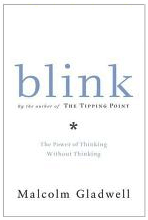
Blink by Malcolm Gladwell (5)

Malcolm Gladwell's writing in Blink (and all of his books) is clear and personable. He makes most of his points with fascinating anecdotes and studies. Every argument has a face. Every point is explained for the layman.

I appreciate that Gladwell does not pretend to be a pure academic, as if objectivity were something any person could achieve. Unfortunately, in explaining his ideas simply, he crosses from clarity into redundancy. Often I would worry I had lost my place and was re-reading an earlier paragraph, until I recognized his habitual repetition. I also had to slough through some unnecessarily detailed research. Okay, so there are thousands of facial muscles movements. I don't need to know exactly which ones form my smile, and what a pair of psychologists have named the combinations. I get that Gladwell researched his ass off for this book, but the self-serving detailed descriptions run contrary to his own points about the dangers of information overload.

But, I do love his theories. Gladwell reveals things we have forgotten about ourselves, or that we choose to ignore. In Blink, we are reminded that we are not just Platonic forms of humans - our bodies and our minds are interwoven. And it is wisdom (understanding), not knowledge (information) that we need.


Thursday, January 14, 2010

The Road by Cormac McCarthy (4)

Okay?
Okay.

The reader of The Road follows a father and son through lucky windfalls and near deaths on a south-bound journey, piecing together an image of a bleak, ash-covered country and its hopeless survivors. It is a slow and arduous read to match the trip. Several scenes in the book were completely horrifying, despite my desensitization to the idea of cannibalism from reading science fiction.

There are only snippets of memory from the pre-apocalypse world. These glimpses, and the man's poetic reflections, are the most beautiful and stirring passages. Much of the prose resembles stream of consciousness narration, and the dialogue is as boring as talking to an actual person. The disaster and its cause are mostly mysterious and the reader can only guess it has something to do with worldwide fire.

I'm not really glad I read this. I was perplexed by the boy, who was far too guileless for a child who has only known a decimated world populated with cannibals. I was also disappointed with the only half-believable conclusion. The improbable half was hastily tacked on and then abandoned. It was too convenient, but perhaps was part of the pattern of the traveling family's occasional luck. The Road didn't offer unusual perspectives on a common theme. A post-apocalyptic novel must always ponder the value of morality after the destruction of society, inhumanity during scarcity and terror, and methods of survival and adaptation. There was enough suspense keeping me interested in whether the "bad guys" would catch the homeless family, but I admit I nearly fell asleep as I began it on the subway two or three times.

I don't even think I want to see the film anymore.

Monday, January 11, 2010

Cat's Cradle by Kurt Vonnegut (3)

Cat's Cradle buttered my Kurt Vonnegut muffin, so to speak. I was forewarned about the plot's "mind-fuck", but not about the satirical hilarity. The plot didn't blow my mind, though, since I am a huge science fiction fan and adore post-apocalyptic musing. Vonnegut's endless humor was addicting, and I finished the book almost immediately.

For all the unusual thoroughness of the novel, including a fictional religion, imagined co-creator of the atom bomb, and fake island nation that are all so detailed you could practically convert and move there, the characters are empty. The only bit of emotional realism I remember revolves around the princess of the island, who loves and is loved by all. Even after the end of the world, the despair of the narrator and survivors is a side note. The priority is clearly parody, rather than plot or characters. And more than anything, it is a commentary on religion. John-call-me-Jonah, the narrator, misunderstands Christian theology enough to leave that faith to follow the same ideas in the fictional Bokononism. I wasn't a Lit major in college, and so do not have the benefits of reading the Sparknotes here, but it seems more like Vonnegut's misunderstanding than him writing the character's mistake. (Welcome any corrections here. I'm not a professional)

Wednesday, January 6, 2010

The Alchemist by Paulo Coelho (2)

The Alchemist is swift and grand. It sweeps over a transcontinental journey, enormous life changes, and vast philosophies without wordiness. Brevity is power, and the book quickly snared my affection. A seminarian becomes a shepherd (symbolism!) out of wanderlust, dreams of a great treasure and forsakes the safety of familiarity on a mission to complete his life's narrative. It is an adventurous, romantic, philosophical coming-of-age tale in 167 pages. Every character was likable, even the thieves and bandits. How could I hate them, knowing they were each an important part of Santiago's quest?

The story is warm, the writing poetic and the message inspiring, despite the pantheism. I consumed this book and felt nourished and encouraged. It is an optimistic fantasy, but surprisingly pertinent. Discovering desires we have suppressed, resisting the easy routine, trusting instincts, accepting opportunities, conquering disappointments on the way to a higher goal - it is the most enjoyable self-improvement book I have read yet. Some might think it is too idealistic or too pagan. They wouldn't be wrong. But with captivating images, charming characters and a satisfying conclusion, there is only everything to love about this short book.

Tuesday, January 5, 2010

Olive Kitteridge by Elizabeth Strout (1)

Olive Kitteridge is a collection of short stories that create a picture of the title character. Some of the vignettes are told from Olive's perspective. In others she is practically unmentioned, except for a single comment she has made to a former student, or an appearance at a local restaurant. Olive is not a particularly likable character. She is the scariest teacher at the local junior high, critical of her neighbors and family, unapologetic for her faults and mistakes, and seems incapable of reflection or introspection. So why write a book about an ordinary town and its crankiest old lady?

Few characters in this book are admirable. But they are all so real. Olive may be the bitchy wife and mother that she seems from the initial story, but she is also compassionate, individual, unrelenting. Olive and the locals don't play archetypes. They are sad, struggling people, in the way that the readers probably are. Anorexia, divorce, affairs, strokes, unhappy families, suicidal thoughts, unemployment, break ups are all quite trivial in a global perspective. They don't live with a global perspective, no one really does. We all have absolutely common problems that plague, confuse, and transform us.

I was bored, occasionally, by the ordinariness, but Strout's writing was pleasant and strong. It was unusual to read about the conflicts and hardships of the elderly, so much death, loss and change. I never came around to liking Olive. But you don't have to like Olive, or any of the other characters, to learn something from the book. It left me wondering how well I can really know other people. It made me certain that I need to be willing to change and accommodate others if I want to be happy. It also reminded me about the importance and rarity of genuine kindness, acts not coated in fake sweetness, but done for the good of doing them. Goodness is not a thing people are, but a thing people do.

Monday, January 4, 2010

Books, Chords, Minimalism

The time for resolution is here!

Large goals:

I resolve to read (at least) 52 books this year. That is one book a week.
In addition, I resolve to write reviews of these 52 books.

Incremental goals:
I resolve to play my guitar every day, even if all I do is pick it up and strum it once.
I resolve to go to the gym at least once a week, even if all I do is use one machine.

Vague, philosophical goals:
I resolve to embrace minimalism in my life!

Thursday, December 3, 2009

You're Not Too Old If You're Still Alive

I'm not sure what it is that prevents us from realizing we can mold our identities as we age. Perhaps it is a culture of youth worship, societal laziness or communal pessimism, but we get the message very early: You must decide who you will be for the rest of your life when you are a child.

I was ten or so when I became aware of this discouraging idea. I noticed that girls in my dance class who had been there since age 3 had a distinct advantage over me, even though I began at age 6. I didn't consider at that time that it was merely more time dancing and practicing had made them better dancers. They only had 3 years of a head start. Instead, subconsciously looking for an excuse to underachieve, I determined that only those who had been dancing since infancy had any chance of tap dancing enlightenment. I was too late. I would never be good. This message I absorbed is contradictory to the parental mantra "You can be anything you want" and Disney's inescapable "Believe in yourself and your dreams will come true." My mother was always telling me that I just needed to practice more, but honestly, who listens to their mother?


Of course, my mother was right. I was a child and quit dance class at 14 to pursue the more promising High School Track & Field career. No one ever questioned my worldview: succeed young or die a failure.

What I didn't know was that I could live my life differently. My quest for an identity, an occupation that thrilled me didn't end with my teens. In 2009, I realized that as long as I think, I am, and I can change directions, start a new hobby, seek a better career. So what if I didn't learn guitar in my teens? I'm starting now. My identity is not fixed, neither is my vocation.

I'll never be too old to learn something new as long as I'm alive.